Background of the birth of technology Essential For Life
The key to ammonia synthesis is “Essential For Life”.
(Hideo Hosono, Professor Emeritus, Tokyo Institute of Technology)
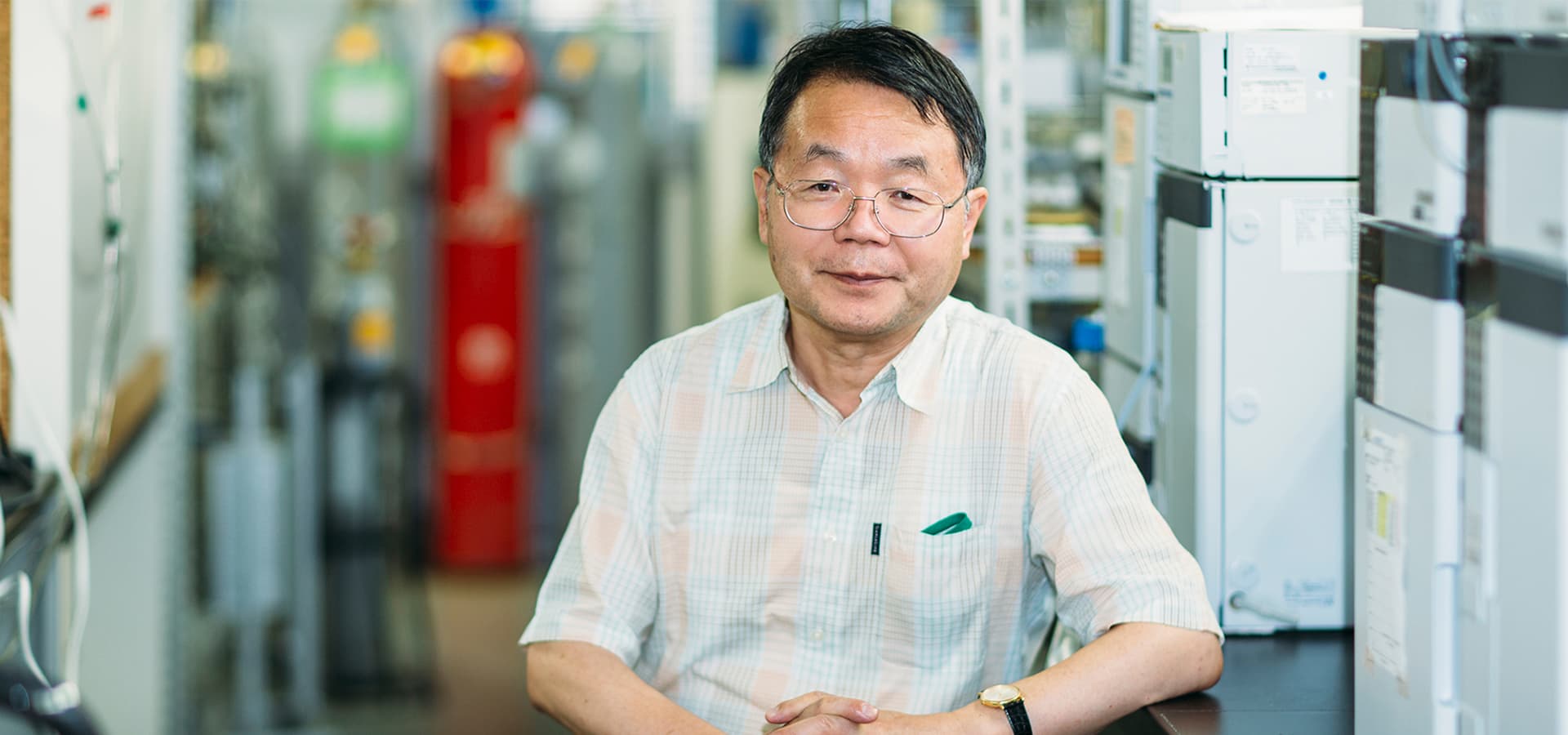
“It would be interesting if it exists, but is it essential?”
Just when we started to see the practical application of the transparent semiconductor IGZO thin film transistor that we developed into a display, we received a request from a magazine for an explanation. At that time, I got a simple question from one of my collaborators. "What can a transparent display do for?" The simple question made me aware that the transparent and high-performance IGZO semiconductor contributes to the "Better life," but not the "Essential For Life." It was a turning point that I was made to realize again that “I wanted to make an essential contribution to the world as a researcher”, which I had been thinking about in my research.
When I thought about food, clothing and shelter that everyone needs, I focused on "food". It was "ammonia" that I thought about in my research on food. Ammonia is widely used as a raw material for foods, pharmaceuticals, fertilizers, etc. The synthetic method that produces ammonia is the Haber-Bosch process (HB process) that was industrialized in Germany in 1913 and is still used today. The manufacturing method has not changed for more than 100 years. At that time, there were few research reports, and when I studied it by searching for the information on the internet and discussing with the people related to synthetic catalysts, I found that there were not many researchers. The HB process requires high-temperature and high-pressure conditions for reacting with nitrogen, which results in mass production in a large plant. If this can be reacted at a low temperature and low pressure, the equipment can be downsized, and the required amount can be manufactured at the required size of place. With that aim, our research has started.
The scenery when stopped and when running is different.~The road to electride catalyst~
It has long been suggested that electron donation is important for the operating principle of the catalyst used in the HB process. If this suggestion is true, I thought that it may be possible to apply our electride, which has a low work function comparable to that of alkali metals (high electron donating ability) and higher thermal and chemical stability, which are usually contradictory properties. In the previous joint research with others, I tried to apply the electride matrix as a catalyst, but the surface was different from the inside structure, and only moderate effect was obtained. Of course, I was reminded that the surface is the key in the catalytic reaction. Therefore, in the case of electride, Dr. Toda, who was in the doctoral course, made a single crystal, broke it under ultrahigh vacuum, thoroughly investigated it with an atomic resolution scanning tunneling microscope for 3 years, and accumulated that knowledge. Given this background and accumulation, we were confident that electride could be applied to ammonia synthesis catalysts.
When I started research on electride catalysts, I initially wanted to do it within the FIRST (Funding Program for World-Leading Innovative R&D on Science and Technology by Cabinet office). However, the theme adopted by FIRST is related to research on new superconducting materials centered on iron pnictide, which was discovered in 2008 and became a fuss, so when the government was reelected and the budget was reduced, the promotion committee pointed out that it is better to cut it because the ammonia synthesis catalyst is irrelevant. However, I thought that we did not need such a large amount of money, so I dared to ignore it and start my research. I thought, "If there is a result, there should be no problem." When we started the research, we explained our aim to our colleagues, Prof. Hara and Associate Professor Kitano, who are experts in catalytic chemistry, and asked for their cooperation. Fortunately, they kindly agreed, and the joint research started. Although I continued to research in collaboration with Professor Hara and Associate Professor Kitano, we were not able to get the results I expected for about half a year. Wet processes are the most common catalyst preparation process, but electride did not work well with it. We repeated trial and error, such as changing to a dry process and improving the process and metal loading method to obtain the original surface of electride. At that time, we were able to make use of the fact that we had been doing basic research firmly, including the surface of electride. After that, we were able to successfully obtain highly active results with the electride catalyst.
I submitted the results of my research to Nature Chemistry, but it was rejected because it was said that the temperature was not so low and that the materials and methods were not new (this was a complete misunderstanding). We thought we could see the goal, but we did not get approved, so we did the experiment again. During the experiment, Associate Professor Kitano discovered that hydrogen poisoning, which has been an obstacle to conventional catalysts, does not occur. And the cause has become clear. Also, because the explanation about electride was insufficient, we revised the paper significantly. When we posted it again to Nature Chemistry, it was immediately recognized as novel and was published in October 2012. The issue was accompanied by a commentary by an expert called "Teaching an old material new tricks", and it was introduced that a new catalyst was created with a new idea for an old substance (cement mineral). In addition, the FIRST program highly evaluated it as one of the best evaluations. To tell the truth, I am used to this kind of procedure for the judges. In this case, it happened because they were unfamiliar with the concept of the electride substance.
The IGZO transistor, which is currently used to drive pixels on the screens of OLED TVs and high-resolution liquid crystal displays, was not immediately recognized in the early stages of research. In a nutshell, it often happens in the early days of research results that have never existed before. Through this research, I realized that the scenery when stopping is different from the scenery when running. Although it did not go according to the original plan, I experienced what I could try and understand, and as I went along, I could see new ways.
The initial plan is just a start, and after that, I think it is important to respond flexibly according to the results of the process.
Tsubame BHB standing at the starting line
Tsubame BHB Co., Ltd. was the first company that Tokyo Institute of Technology established as a research site on campus. The university side also supports me completely. Dr. Yasunori Inoue and Dr. Kazuhisa Kishida, who are promoting the business at Tsubame BHB, are former postdocs of the FIRST project. In other words, they are doing their utmost to work at the start-up company that was established for the purpose of industrializing the technology, the results of their direct research. We hope that their activities will serve as a model case for postdoctoral career paths and will be an opportunity to increase such cases in Japan.
The other day, the model plant was completed. We have taken a big step toward mass production. However, Tsubame BHB started in earnest from here. It is expected that many issues will come up by operating the model plant and mass production. But, I would like Tsubame BHB to overcome them with the help from all the employees at Tsubame BHB and make this firm visible to the world. Of course, my laboratory at the university will also work in a complementary and collaborative manner, aiming for further heights. And in the future, I hope that through ODA (Official Development Assistance), it can be manufactured in developing countries that need ammonia. If my research result becomes “Essential For Life,” I am on my way of becoming a researcher that I aspired to be.